

Perfect Assignment Creator vs. Traditional Writing Services: Which One Should You Choose?
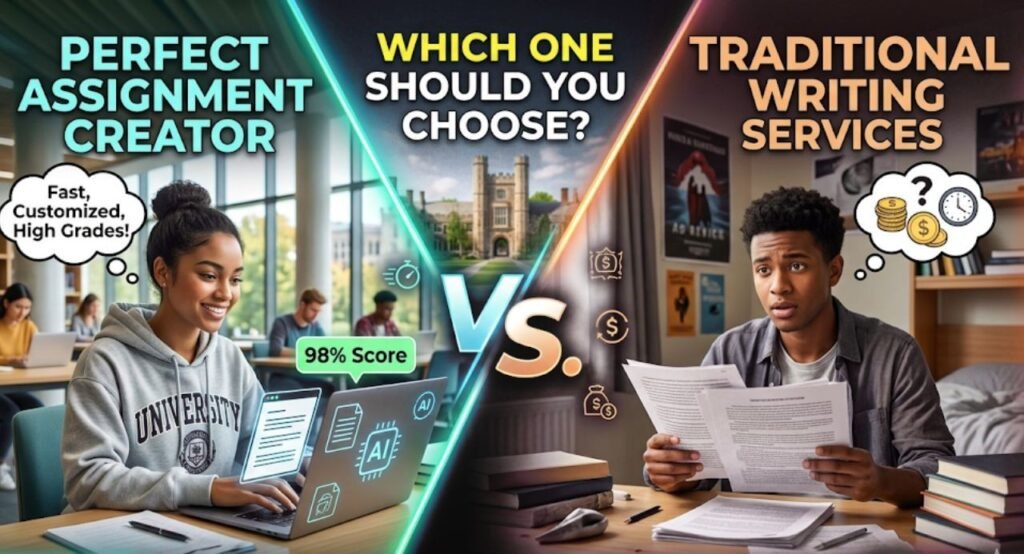
Perfect Assignment Creator vs. Traditional Writing Services: Which One Should You Choose? Compare both to find smarter, faster academic help!Let me paint you a picture. It’s 11:47 PM on a Tuesday. Your assignment is due at midnight. You’ve been staring at a blank Word document for the last forty minutes, watching that cursor blink like it’s judging you. Your notes are scattered across three different apps, your brain is fried from a full day of classes, and the only thing you’ve typed so far is your name, which you then deleted and retyped twice just to feel productive. Sound familiar? If you’re a student in 2026, you know this feeling all too well. And in moments like these, two options tend to flash across your mind: fire up an AI-powered assignment creator, or head over to a traditional writing service and hand your problem to a real human writer. Both promise to save you. But they’re wildly different in how they do it — and which one is actually right for you depends on more factors than most people realise. This blog is going to break it all down. Clearly, and without trying to sell you anything. First, Let’s Understand What We’re Actually Comparing Before we can pit these two options against each other, it helps to understand what each of them actually is. Assignment Creators are tools built on large language models — think of them as sophisticated writing engines that can generate essays, research papers, reports, case studies, and more based on the instructions you give them. You type in your topic, your requirements, maybe a few bullet points of what you want covered, and the tool produces a full draft in seconds or minutes. Some of these tools are standalone platforms designed specifically for academic writing. Others are general-purpose assistants that students have repurposed for the task. Traditional Writing Services, on the other hand, are platforms that connect students with human freelance writers — usually people with academic backgrounds, subject matter expertise, and experience writing for specific fields. You submit your assignment brief, and a real person researches it, writes it, and delivers it back to you within a set deadline. These services have been around since the early 2000s and have built entire industries around student demand. Both exist to solve the same core problem: a student needs written content they can’t — or don’t want to — produce on their own. But the experience, the output, and the trade-offs are completely different. Let’s dig in. Speed That No Human Can Match The most obvious advantage of an AI tool is the turnaround time. We’re not talking hours — we’re talking minutes, sometimes seconds. You paste in your assignment prompt, adjust a few parameters like word count and tone, and the tool delivers a complete draft before you’ve had time to finish your cup of coffee. For students working under tight deadlines, this is massive. When you’ve got thirty minutes left and three hundred words to go, no human writer on the planet is going to save you — but an Assignment Creatorcan. Cost: Dramatically Lower Most traditional writing services charge by the page or by the word, with rates that typically range from $10 to $50+ per page, depending on the complexity of the subject and the urgency of the deadline. For a 10-page research paper due in 24 hours, you could be looking at several hundred dollars. AI tools, by contrast, are usually subscription-based or free at the basic level. Even premium tiers of most AI writing platforms are a fraction of the cost of hiring a human writer. If you’re a student on a budget — which, let’s be honest, is most students — this difference matters enormously. Availability Around the Clock It’s Sunday at 3 AM, and inspiration (or panic) strikes. With an AI tool, that’s fine. These platforms are available 24/7, never offline, never too busy, never booked up. You don’t need to wait for a writer to accept your order, you don’t have to work around someone else’s schedule, and there’s no back-and-forth communication to slow you down. Creative Control and Instant Iteration Here’s something people don’t talk about enough: with AI tools, you’re in the driver’s seat. Don’t like the introduction? Regenerate it. Want the tone to be more formal? Say so and watch the tool adjust in real time. Need to add a counterargument to paragraph three? Just ask.This kind of instant iteration is something traditional writing services genuinely can’t offer at the same pace. Revision requests with human writers can take hours or even days, and you may only get a limited number of revisions included in your package. Great for Structure and Starting Points Even if you plan to write the bulk of your assignment yourself, AI tools are fantastic for generating outlines, suggesting arguments, creating rough drafts you can then refine, or simply overcoming that dreaded blank-page paralysis. Many students use AI creators not as a f inal product generator but as a thinking partner — something to bounce ideas off and get the structure going.
The Case for Traditional Writing Services Genuine Human Expertise Here’s the thing that AI tools still haven’t fully cracked: true subject-matter expertise. When you hire a human writer with a PhD in biochemistry to write your biochemistry paper, they bring lived knowledge, nuanced understanding, and the kind of contextual awareness that comes from years of studying a field. They know which arguments are well-worn and which are genuinely insightful. They know the current debates in the literature. They know how professors in that discipline actually think. AI tools have broad knowledge, but they don’t always have deep expertise. They can generate text that sounds authoritative in almost any field, but there’s a difference between sounding authoritative and actually being authoritative — and in academic writing, that gap can show up in the quality of the arguments, the relevance of the citations, and the sophistication of the analysis. For highly specialised or advanced-level assignments — final year dissertations, graduatelevel papers, technical reports in niche fields — a skilled human writer often produces demonstrably better work. Personalisation and Communication When you work with a good writing service, you can have a real conversation with your writer. You can explain your professor’s quirks, your specific course’s emphasis, the particular angle you want to take, even your own writing style if you want the final product to sound like you. Human writers can absorb all of this nuance and reflect it in their work. AI tools can process instructions, but they don’t truly understand context in the same way a human does. If your assignment needs to reflect a specific class discussion you had last week, or incorporate feedback your professor gave you on your previous paper, or match the voice you’ve established in prior submissions, a human writer can handle that. An AI tool will need extremely precise, detailed prompting to come anywhere close.Accountability and Reliability Reputable traditional writing services operate with real accountability structures. If the delivered work doesn’t meet the agreed specifications, you can request revisions, escalate complaints, or request a refund. There’s a human on the other end of that transaction who has professional stakes in delivering quality. AI tools, while improving rapidly, can still produce errors, hallucinate sources, get facts wrong, or generate content that sounds plausible but contains subtle inaccuracies. And when they do, there’s no one to escalate to — just you, staring at a draft that cited a study that doesn’t exist.
Research-Heavy Assignments For assignments that require extensive, accurate, properly cited research — literature reviews, annotated bibliographies, empirical analysis papers — a skilled human researcherwriter is often the more reliable choice. They can navigate academic databases, identify credible sources, and synthesise information in ways that reflect genuine scholarly rigour. AI tools can suggest citations, but they have a well-documented tendency to confabulate references — generating citations that look legitimate but lead to papers that don’t exist, or misattributing quotes to the wrong authors. For anything where citation accuracy is critical, this is a serious problem. The Downsides You Need to Know About Let’s be honest about the weaknesses on both sides, because any blog that only tells you the good stuff is wasting your time. Where AI Assignment Creators Fall Short Generic output. AI-generated text, even when it’s technically well-written, can feel flat, formulaic, and distinctly impersonal. It often follows predictable structural patterns, uses common transitional phrases, and lacks the personality or analytical sharpness that distinguishes truly good academic writing. Professors who read thousands of papers per year are increasingly good at spotting this. AI detection risks. Most universities now use AI detection tools, and while these tools are imperfect, submitting AI-generated content as your own work carries real academic integrity risks. The ethical question here is also real: there’s a difference between using AI as a writing aid and submitting AI output as your own work. Accuracy issues. As mentioned above, AI tools can and do generate factually incorrect statements, particularly in specialised domains or when dealing with recent developments that fall outside their training data.No original research. AI can synthesise what’s already known, but it cannot conduct original research, run experiments, gather primary data, or produce genuinely novel insights. For research-based assignments, this is a fundamental ceiling.
Where Traditional Writing Services Fall Short The cost is real. For many students, especially those from lower-income backgrounds, the pricing of traditional writing services is simply out of reach. A 15-page paper with a 48-hour deadline can easily cost $200–$400. That’s not pocket change. Turnaround times have limits. If you need something in two hours, most traditional services will struggle — or charge a massive rush premium that makes the cost even more prohibitive. Quality is inconsistent. Not every writer on every platform is good. Some writing services have robust vetting processes; others are essentially open marketplaces where quality can vary wildly. Getting a bad writer, or a writer who doesn’t understand your field, is a real risk. The same ethical concerns apply. Let’s not pretend that submitting work written by a human ghost-writer is ethically cleaner than submitting AI-generated content. Both involve submitting work that isn’t yours. The academic integrity issue doesn’t disappear just because a human wrote it. So, How Do You Actually Decide? Here’s a practical framework. Think about your situation and ask yourself these questions: 1. How much time do you have? Less than a few hours? AI is your only realistic option. More than 24–48 hours? Both options are on the table. 2. How complex and specialised is the assignment?Introductory-level general essays? AI handles these well. Advanced, technical, or specialised work? Human expertise starts pulling ahead. 3. What’s your budget? Limited budget? AI wins on cost, almost every time. Isn’t the budget the issue? Then prioritise quality and fit for the specific task. 4. How much do you need the output to sound like you? If it needs to match your established voice and prior work, a human writer whom you can brief thoroughly will do a better job. If voice isn’t a critical concern, AI can work fine. 5. Does citation accuracy matter critically? For research-heavy assignments where sources will be scrutinised, human writers are significantly more reliable. 6. What’s your plan for the output? If you’re using the AI draft as a starting point, you’ll heavily revise. AI tools are fantastic. If you need a polished final product with minimal editing on your end, human writers generally deliver more reliably. The Middle Ground: AI-Assisted Human Writing By 2026, that clear divide between “human-written” and AI-created content just isn’t there anymore. Tons of writing services now bring AI into the mix to speed things up for their writers, which honestly makes you wonder what you’re really paying for when someone claims their content is “human-written.” But let’s be real. Most students don’t stick with just one method. The smartest move is often mixing both—let an AI tool whip up your outline or rough draft, then team up with a human editor to sharpen your arguments, fix the tone, and get the details right. This strategy nets you the speed and budget perks from AI, but you still get the careful polish only a person can deliver. There are also AI tools built for academic integrity—ones that point out gaps, suggest improvements, and push you to develop your own arguments. They don’t write for you; they help you write better. These are nothing like content generators, and if you care about improving your skills, this route is way more ethically straightforward. Academic Integrity Let’s not sugarcoat it: this topic calls for honesty. Both AI assignment generators and traditional writing services hang out in a weird grey zone when it comes to academic integrity. Most universities spell it out—if you submit work that isn’t yours, whether produced by a human or a bot, you’re breaking the rules. Still, in practice, lots of students use these services, and enforcement is patchy. The risk? It’s real, and the fallout can be brutal—anything from zeroes to suspension or expulsion. But there’s something even bigger here. The main point of learning to write isn’t just to tick assignment boxes—it’s about training yourself to think clearly and communicate persuasively. These skills matter everywhere: your job, your relationships, any time you need to argue a position or make yourself understood. The more you let other people (or machines) think for you, the fewer chances you get to grow those skills. So, be smart. Use these tools to learn, to get started, to get better. Don’t just rely on them to duck the real work. Choosing What Works for You There’s no single best option—it all depends on your situation. Go for an AI assignment creator if: You’re up against a tight deadline. You’re short on cash. Your assignment is basic, introductory, or not too specialised. You just want a rough draft to tweak yourself. You need to brainstorm or break out of writer’s block. Pick a traditional writing service when: You’re tackling an advanced or technical topic. You need spotless citations and strong sources. The assignment needs a unique voice or personal touch. You’re willing to pay more for quality.
You want human accountability and revision support. Try the hybrid approach when: You want AI speed plus expert review. The project matters enough to justify both kinds of help. Bottom line? These tools should work for you—not the other way around. The sharpest students know how to mix and match, using each one when it makes sense.And for those nights when it’s nearly midnight and the screen’s just staring back at you, maybe the best move is simple: close the laptop, set the alarm for the crack of dawn, and write it yourself. You might surprise yourself with what you can actually do