

How to Use Writing Assistance Services Responsibly
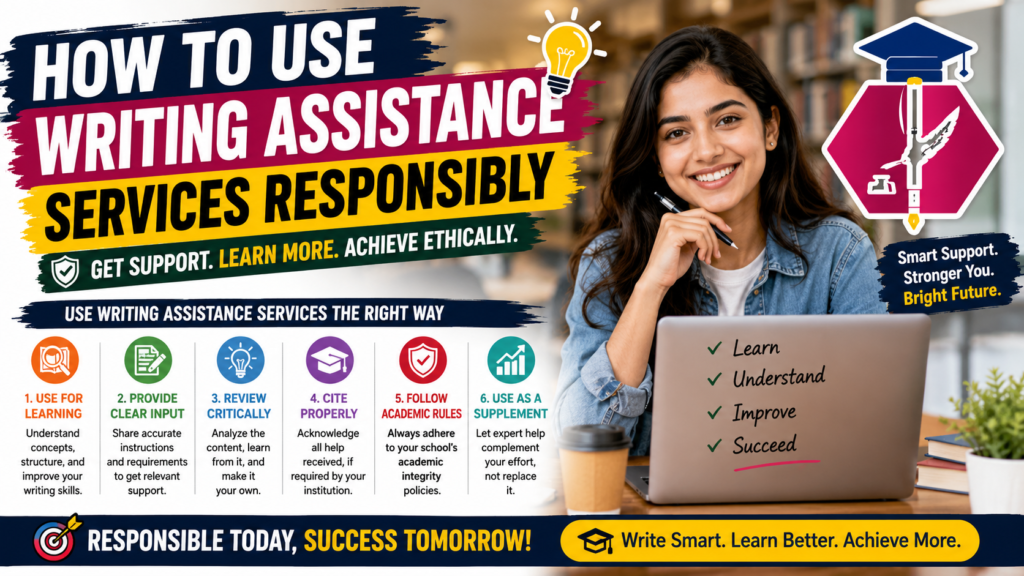
Learn how to use writing assistance services responsibly — boost your skills, maintain academic integrity, and get the most out of every tool available.I’ll be upfront about something. There was a ftime I genuinely believed that anyone who used writing help was just avoiding hard work. That was my actual opinion. Then one night I had to write a 1500-word essay on the French Revolution. It was 11 PM. I had just recovered from a week-long fever. My notes were scattered everywhere and half of them didn’t even make sense anymore. The deadline was the next morning and nobody was going to extend it for me.
That night changed how I think about this whole thing.
I didn’t finish that essay feeling proud. I finished it feeling exhausted and a little humbled. And somewhere in those late hours I started asking a question that I hadn’t really asked before — not “is it okay to ask for writing help” but “what does asking for help actually mean, and when does it stop being help and start being something else?”
That’s what I want to talk about here. Not rules. Not a checklist. Just an honest conversation about writing assistance — what it is, who actually uses it, and how to make sure it’s working for you and not against you.
Why People Actually Look for Writing Help
Nobody sits down and thinks “I want someone else to do my thinking for me today.” That’s not how it works. People look for writing help because something real is getting in the way.
Sometimes it’s time. You have three assignments, a part-time job, a family situation that’s been stressful for weeks, and somehow you’re also supposed to produce a well-structured 1000-word essay by Friday. Sometimes it’s confidence. You have plenty of ideas in your head but the moment you try to put them on paper they come out wrong and flat and nothing like what you actually meant. Sometimes it’s language. English might be your third language and you’re expected to write at a level that native speakers took twelve years of schooling to reach.
These are real situations. They happen to real people every single day.
A student who grew up in a Hindi-speaking household and is now suddenly writing college assignments in English isn’t being careless when they look for help. They’re dealing with a gap that the education system created and never really addressed. A working adult trying to write a formal letter who was never properly taught how to structure one isn’t being lazy. They’re trying to solve a problem with whatever tools are available to them.
Needing help with writing is not a personality flaw. People have always helped each other communicate. Editors exist because even brilliant writers need another pair of eyes. Teachers exist because learning happens better with guidance. Writing assistance is just a newer, more accessible version of something humans have always done.
The real question is not whether to use help. The real question is what you’re actually doing with it.
The Difference Between Using Help and Hiding Behind It
Here’s an analogy that actually makes sense to me. Imagine you sprain your ankle badly and a doctor gives you a crutch. You use it. Your ankle heals. Good. But now imagine you keep using the crutch six months later even though your ankle is completely fine, just because walking feels like more effort than it used to. Your muscles start to weaken. Your balance gets worse. And one day when the crutch isn’t around, you realize walking normally feels harder than it should.
Writing assistance can do the exact same thing to you if you’re not careful.
When you actually read through a corrected version of your own writing and try to figure out what changed and why — your brain is doing something useful. It is slowly building instincts. Every time you catch a pattern in your own mistakes and genuinely try to break it, something sticks. It might not feel dramatic. But it adds up.
The problem comes when the process becomes purely mechanical. You write something rough, you drop it into a tool, something cleaner comes back, you submit it, repeat. No thinking in between. No curiosity about what changed or why. Just output.
Psychologists have a name for what that leads to over time. It’s called learned helplessness. The idea is simple — when we keep bypassing the discomfort of learning something, we eventually start to believe we simply cannot learn it. We stop trying before we even begin. And then the belief becomes real, not because we were actually incapable, but because we never gave ourselves the chance to find out.
The uncomfortable part of writing — the part where you stare at a blank page and feel stupid — that’s not the enemy. That’s actually where the growth is hiding.
What Using These Services Responsibly Looks Like in Real Life
This doesn’t have to be complicated. A few small shifts in how you approach writing assistance make a massive difference.
First thing — always write something yourself before you go looking for help. It doesn’t have to be good. It just has to be yours. Get the ideas out. Write messily if you need to. The goal at this stage is not quality, it’s just getting your own thinking on the page. Then use the service to help you improve what you’ve already started. That way the ideas are genuinely coming from you and the assistance is just helping you express them more clearly.
I had a friend in college who had this habit of writing her first draft by hand. Actual paper, actual pen, messy handwriting, lots of crossing out. She said if she started with any kind of external help she would never figure out what she actually thought about the topic. She was right. And her writing was always more interesting than anyone else’s because it had a real point of view in it.
Second — actually read what comes back. Don’t just scan it to see if it sounds better and move on. Ask yourself what specifically changed. Ask yourself why that version works better than yours did. If there’s a correction you don’t understand, look it up. That confusion you feel in that moment — that’s not wasted time. That’s the actual learning happening.
Third — protect your own voice. This is harder than it sounds. One thing that happens when too many people use the same writing tools is that everyone’s writing starts to sound weirdly similar. There’s a kind of smooth, empty quality to it. Real writing has a person in it. It has a specific way of seeing things that belongs to the writer. When you’re using assistance, push back against anything that sounds too polished or too generic. If a sentence doesn’t sound like something you would actually say, change it until it does.
A simple test — read your finished piece out loud. Any sentence that makes you stumble or that sounds like it came from a legal document rather than a human being — that’s a sentence that needs to go back and be rewritten in your own words.
And fourth — know what your institution or workplace actually allows. Most academic settings are fine with grammar checking tools. Many allow peer feedback and tutoring. Very few allow submitting something that another person or tool wrote on your behalf. Knowing that boundary and staying within it isn’t just about avoiding getting caught. It’s about being someone you can respect when you look back on your own work.
When Writing Assistance Is Genuinely the Right Call
Let’s be balanced about this because the full picture matters.
There are situations where using writing assistance isn’t just acceptable — it’s actually the smart and right thing to do.
For people writing in their second or third language, these services can genuinely change what’s possible for them. A researcher who has spent years developing real expertise in their field shouldn’t have that expertise ignored because their English sentence structure isn’t native-level. Getting help with the language so the actual ideas can come through clearly — that’s not dishonest. That’s practical and fair.
Think about someone like Ravi. He’s a real type of person even if the name is made up. He grew up in rural Andhra Pradesh, studied in Telugu medium until class ten, and then entered a degree college where every assignment was expected in English. His thinking was sharp. His grasp of the subject matter was solid. But every time he sat down to write, there was this wall between what he actually understood and what he could get onto the page in English. For someone in Ravi’s position, a writing assistance service isn’t a shortcut around learning. It’s a bridge that lets his real intelligence show up while he’s simultaneously building his language skills. That’s responsible use, even if from the outside it might look like leaning on a crutch.
For people with dyslexia or other learning differences, writing tools aren’t giving them an unfair advantage. They’re removing a barrier that was never supposed to be there in the first place. The goal of any assessment is to understand what someone knows and can think. Not to penalize them for how their brain processes letters.
For professionals — doctors, engineers, scientists — who are brilliant in their own fields but are writing grant proposals or client reports outside their comfort zone, getting help with structure and tone is just normal. A great surgeon is not expected to also be a great writer. Communication assistance in professional contexts is standard and sensible.
There’s also something worth saying about confidence. A lot of people who struggle with writing aren’t struggling because they lack intelligence or ideas. They’re struggling because somewhere along the way — a harsh teacher, a bad grade, a classroom that made them feel stupid — they were made to feel like writing wasn’t for them. Good writing assistance, used thoughtfully, can start to undo some of that damage. It can show someone that their ideas are actually worth putting on paper and that the mechanics of writing are learnable. That matters more than people give it credit for.
Building a Real Relationship with Writing Over Time
Here is something most people don’t fully believe until they’ve experienced it themselves — writing is not a talent that some people are born with and others aren’t. It is a skill. And skills grow with practice in ways that feel almost invisible until suddenly they don’t.
Every writer whose work has ever moved you — every journalist, novelist, blogger, essayist — was at some point genuinely bad at this. Some of them were embarrassingly bad. The only difference between them and someone who never improved is that they kept writing. They produced bad sentences and then slightly less bad sentences and then one day a sentence that actually surprised them.
Writing assistance, when you use it with your brain turned on, can speed that process up. It can show you your own patterns faster than you’d notice them alone. It can introduce you to ways of structuring ideas you hadn’t thought to try. It can give you enough confidence to keep going when your own instincts feel shaky and unreliable.
But it can only do that if you stay engaged. If you stay curious. If you treat every interaction with a writing tool as a chance to learn one small thing rather than just a transaction that produces a finished document.
Try this. Every time you use writing assistance, write down one thing you noticed. One correction that made sense once you saw it. One sentence structure you hadn’t tried before. One word that fit better than yours did. After a few weeks of this, read back through your notes. You’ll find that you’ve been learning steadily without even realizing it.
One Last Thing
The most important thing about using writing assistance responsibly has nothing to do with tools or rules or word counts. It has to do with what you actually want from the experience.
If what you want is just a finished document, you’ll use these services one way. You’ll get the document, you’ll move on, and six months later you’ll be in exactly the same place you were before — maybe a little more dependent, maybe a little less confident in your own abilities.
But if what you want is to actually get better — to be someone who can sit down and express themselves clearly without needing a safety net every single time — then you’ll use these services completely differently. You’ll stay curious. You’ll ask questions. You’ll push back. You’ll keep your own voice in the work even when it would be easier to just accept whatever comes back.
The tool doesn’t make you a better writer. You make you a better writer. The tool just gives you something to practice against.
Use the help. Just stay in the room while it’s happening.