

UK CV vs Indian CV: Key Differences Every Indian Student Should Know
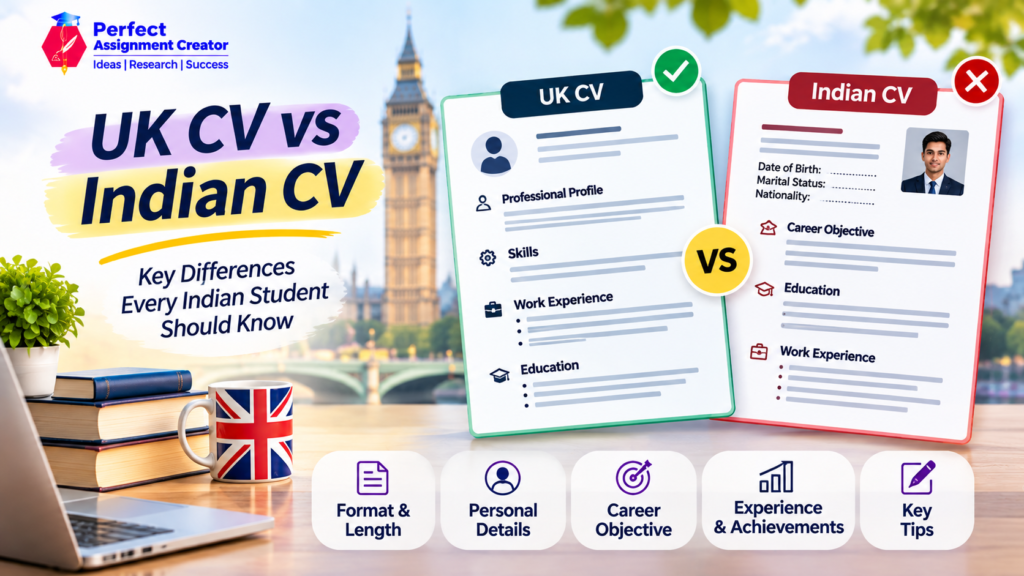
Planning to apply for a job or internship in the UK? Before sending your Indian CV to a British employer, take a moment to review its format.
You might have an impressive academic background, relevant work experience and professional certifications. However, the way you present this information can influence how recruiters assess your application.
A UK CV follows certain conventions that may differ from the formats commonly used by Indian students and job seekers.
For example, personal photographs, date of birth and lengthy career objectives may appear in some Indian CV templates, but these details are generally unnecessary in a UK job application.
Let’s explore the key differences and understand how to adapt your CV when applying for opportunities in the UK.
1. UK CV vs Indian CV: What’s the Difference?
The most important difference is how information is presented and what employers expect to see.
| Feature | UK CV | Indian CV |
|---|---|---|
| Photograph | Generally not included | Sometimes included, depending on employer and industry |
| Date of birth | Not normally included | Present in some traditional templates |
| Marital status | Not included | Present in some older formats |
| Length | Usually 1–2 pages | Usually 1–2 pages for corporate roles; varies |
| Career objective | Short, targeted profile is preferred | Career objective is common in some fresher CVs |
| Language | British English | Depends on employer |
| Experience | Achievement-focused | Varies by industry and application |
| References | Usually provided when requested | Depends on employer |
Important: There is no single standard Indian CV format. Requirements vary between companies, industries and application processes. The table highlights common differences rather than strict rules.
2. Should You Include a Photograph?
One of the most noticeable differences when preparing a UK CV is the photograph.
Some Indian CV templates include a professional photograph, but UK employers generally do not expect one.
For most UK job applications, your CV should focus on your qualifications, experience and skills rather than your appearance.
For your UK CV:
- Do not include a photograph unless specifically requested.
- Avoid adding unnecessary personal information.
- Keep your contact details professional and easy to find.
This helps keep the document focused on your professional suitability.
3. Personal Details: What Should You Include?
Some Indian CV formats contain extensive personal information, but a UK CV generally requires only basic contact details.
| Personal information | UK CV recommendation |
|---|---|
| Full name | Include |
| Professional email | Include |
| Phone number | Include |
| LinkedIn profile | Recommended if relevant |
| Current location | Include city or location if useful |
| Date of birth | Do not include |
| Marital status | Do not include |
| Nationality | Generally not needed |
| Passport number | Do not include |
As an Indian student already studying in the UK, you can include your current UK contact number and location.
You do not need to provide your passport number or detailed immigration information on your CV. Answer relevant work-eligibility questions separately when an employer requests them.
4. Career Objective vs Professional Profile
Another common difference is the introductory section.
Some Indian fresher CVs begin with a lengthy career objective explaining what the candidate hopes to achieve.
A UK CV generally benefits from a short, targeted professional profile explaining your relevant skills, background and career interests.
Example of a generic career objective:
“Seeking a challenging position in a reputed organisation where I can utilise my knowledge and develop my professional skills.”
A stronger UK-style profile:
“Recent MSc Business Analytics graduate with practical experience in data visualisation, statistical analysis and Excel. Interested in applying analytical skills to business decision-making and reporting.”
The second example gives recruiters a clearer understanding of your qualifications and suitability.
5. CV Length and Formatting
A professional UK CV should be easy to read and navigate.
For most graduate and professional job applications, one or two pages are suitable. Academic CVs for research and university positions may be longer.
Follow these formatting tips:
- Use clear fonts such as Arial or Calibri.
- Keep font sizes readable.
- Use consistent headings and spacing.
- Present experience in reverse chronological order.
- Use bullet points instead of lengthy paragraphs.
- Avoid unnecessary graphics and decorative elements.
Recommended UK CV structure
- Name and contact details
- Professional profile
- Key skills
- Work experience
- Education
- Projects and achievements
- Certifications and additional information
Students with limited employment experience can place education and relevant academic projects higher on the page.
6. Highlight Achievements Instead of Just Responsibilities
UK employers want to understand what you can contribute, not simply what duties you performed.
Compare these examples:
Indian-style description:
“Responsible for managing social media accounts and preparing marketing reports.”
Stronger UK-style description:
“Managed social media content across three platforms and prepared monthly performance reports to evaluate audience engagement.”
The second example provides a clearer picture of your responsibilities and contribution.
Whenever possible, include measurable results, but never invent figures or achievements.
7. Use British English and UK Terminology
When applying to British employers, make sure your CV uses appropriate British English.
For example:
| American English | British English |
|---|---|
| Organization | Organisation |
| Analyze | Analyse |
| Program | Programme |
| Center | Centre |
| Labor | Labour |
| Specialize | Specialise |
Also, explain your Indian qualifications clearly.
For example, mention your degree, university, graduation year and CGPA or percentage as awarded. Do not convert your grades into a UK classification such as a 2:1 unless an official equivalency or employer instruction supports it.
8. Make Your UK CV ATS-Friendly
Many employers use Applicant Tracking Systems (ATS) to manage applications.
To make your CV easier to process:
- Use standard headings such as Education and Work Experience.
- Include relevant keywords from the job description.
- Avoid complicated tables, graphics and multiple columns.
- Use a simple, consistent layout.
- Follow the employer’s requested file format.
A simple CV is often more effective than an overly designed template.
9. Common Mistakes Indian Students Should Avoid
Before submitting your UK CV, check that you haven’t made these mistakes:
- Including unnecessary personal information.
- Using the same generic CV for every application.
- Writing lengthy career objectives.
- Adding irrelevant school-level details when you have stronger qualifications.
- Using Indian spelling conventions inconsistently.
- Listing responsibilities without explaining achievements.
- Submitting a CV without proofreading it.
Final Thoughts
Adapting your Indian CV to a UK format doesn’t mean changing your qualifications or hiding your previous experience.
It means presenting your education, skills and achievements in a way that matches the expectations of your target job market.
For Indian students planning to study or work in the UK, understanding the UK CV format is an important step towards preparing successful job and internship applications.
Keep your CV clear, relevant, achievement-focused and tailored to each opportunity.
Remember: Your experience may be the same, but presenting it in the right format can make a meaningful difference.
Sources:
- UK National Careers Service – How to Write a CV
- University of Dundee – CV Writing Guidance for International Students
- Liverpool John Moores University – Understanding UK CVs and Cover Letters
Read our previous blog here!