

My Literature Review Keeps Getting Rejected: What Am I Doing Wrong?
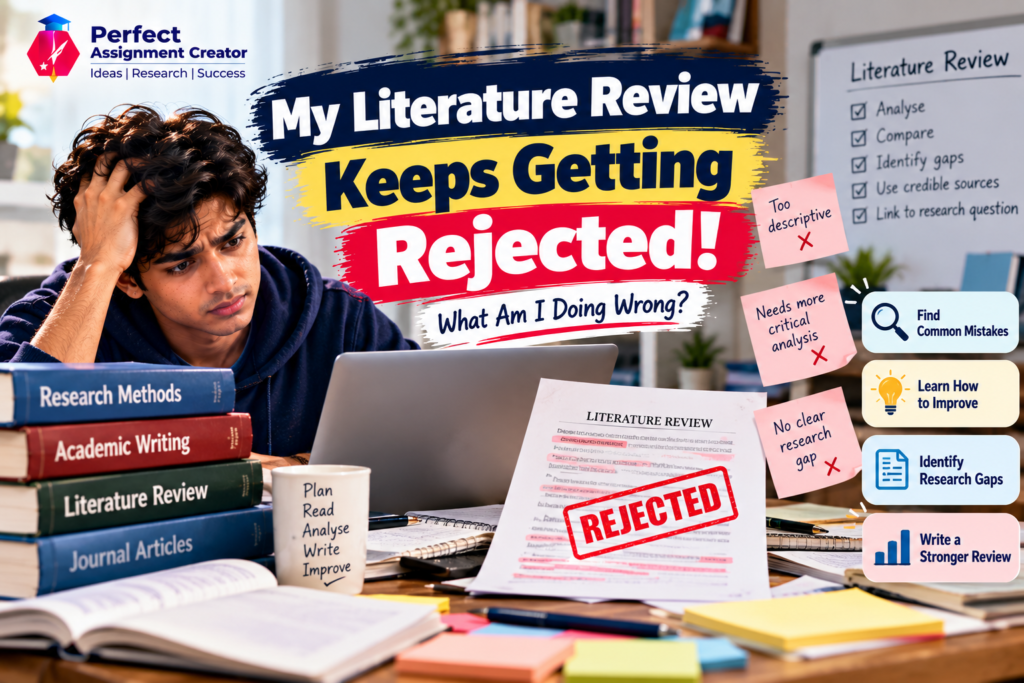
You have spent hours searching Google Scholar.
You have collected journal articles.
You have added references.
You have written page after page.
And then your lecturer or supervisor gives you the same feedback:
“This literature review is too descriptive.”
“You need more critical analysis.”
“There is no clear research gap.”
Frustrating? Absolutely.
For Indian students preparing to study abroad or already studying at universities in the UK, Australia, Canada, Malaysia and other countries, writing a literature review can feel very different from simply summarising what researchers have said.
The good news is that rejection does not necessarily mean your research is poor.
Often, the problem is how you are organising, comparing and evaluating the literature.
Let’s look at the most common issues.
What Is a Literature Review Actually Supposed to Do?
A literature review is not simply a collection of summaries.
Its job is to show:
- What is already known
- What researchers disagree about
- What evidence is available
- What limitations exist
- What has not been adequately studied
- Why your research is necessary
Think of it as a conversation between researchers.
Researcher A
    ↕
Researcher B
    ↕
Researcher C
    ↕
Your analysis
    ↓
Research gap
    ↓
Your research
A strong literature review connects these ideas rather than discussing each paper separately.
1. Your Literature Review Is Too Descriptive
This is probably the most common reason students receive negative feedback.
Descriptive writing
Smith (2022) found that social media influences consumer behaviour. Jones (2023) also found that social media affects purchasing decisions. Brown (2021) examined social media use among young consumers.
You’ve told the reader what each researcher said.
But you haven’t done much with that information.
More critical writing
Smith (2022) and Jones (2023) both identify social media as an important influence on purchasing behaviour. However, their studies focus on different consumer groups, which may explain differences in their findings. Brown (2021), meanwhile, focuses specifically on younger consumers, suggesting that the effect may vary according to demographic characteristics.
Now you’re comparing and evaluating.
2. You’re Treating Every Source as Equally Reliable
Not every academic source is equally useful.
When reading a study, ask:
| Question | What to consider |
|---|---|
| Who conducted it? | Researchers, institution |
| When? | Publication date |
| Where? | Country or context |
| How? | Research method |
| Who? | Sample/population |
| Limitations? | Weaknesses or constraints |
| Relevance? | Connection to your topic |
For example, a study based on 50 participants in one city may provide useful insight, but it may not represent an entire country.
That’s where critical evaluation comes in.
3. You’re Organising the Review Paper-by-Paper
A weak structure often looks like this:
Smith → Jones → Brown → Patel → Williams
This creates a list of summaries.
A stronger literature review is usually organised around themes, concepts or debates.
Example
Instead of:
Smith
Jones
Brown
Patel
Try:
Theme 1: Consumer Trust
       ↓
Theme 2: Online Reviews
       ↓
Theme 3: Purchase Intention
       ↓
Theme 4: Research Debate
       ↓
Research Gap
This makes it easier for the reader to understand the bigger picture.
4. You Have Sources, But No Research Gap
Your supervisor may ask:
“What is the gap?”
And you may think:
“I’ve found 30 papers. Isn’t that enough?”
Not necessarily.
A research gap is an area where existing knowledge is limited, inconsistent, outdated or incomplete.
A simple gap-finding process
What has been studied?
          ↓
What are the main findings?
          ↓
Where do researchers disagree?
          ↓
What has been overlooked?
          ↓
What needs further research?
For example:
Existing studies examine online grocery purchasing behaviour in the UK, but relatively little research focuses specifically on how delivery reliability affects loyalty among international consumers.
That gives your research a clearer reason to exist.
5. You’re Using Too Many Sources Without a Clear Purpose
More references do not automatically create a better literature review.
Imagine reading this:
Smith says X. Jones says Y. Brown says Z. Patel says A. Williams says B.
The reader may eventually ask:
“So what?”
Instead, use sources strategically.
Think:
Evidence → Comparison → Evaluation → Meaning
A smaller number of highly relevant studies can sometimes be more useful than a large collection of loosely related sources.
6. Your Paragraphs Don’t Have a Clear Argument
Each paragraph should have a purpose.
A useful structure is:
Point → Evidence → Analysis → Link
Point: Introduce the idea.
Evidence: Support it using academic sources.
Analysis: Compare, question or evaluate the evidence.
Link: Explain how it connects to your research topic.
Visual formula
POINT
  ↓
EVIDENCE
  ↓
ANALYSIS
  ↓
LINK
This simple structure can make your literature review much more coherent.
7. You’re Not Connecting the Literature to Your Research Question
This is a major problem.
Your literature review should not feel like a separate essay.
Every major section should help answer:
“What does the existing literature tell me about my research question?”
At the end of a section, ask:
Why does this matter for my study?
That one question can help you remove unnecessary information and keep the review focused.
What Does a Strong Literature Review Look Like?
| Weak Approach | Stronger Approach |
|---|---|
| Summarises studies | Compares studies |
| Lists references | Uses evidence purposefully |
| Focuses on what authors said | Evaluates what findings mean |
| Treats sources equally | Considers strengths and limitations |
| No clear gap | Identifies a research gap |
| Paper-by-paper structure | Theme-based structure |
| Separate from research question | Directly supports research question |
A Quick Literature Review Self-Test
Before submitting your draft, ask yourself:
☐ Have I grouped studies by themes?
☐ Am I comparing researchers?
☐ Have I identified disagreements?
☐ Have I discussed limitations?
☐ Have I evaluated the quality and relevance of evidence?
☐ Have I identified a research gap?
☐ Does every major section connect to my research question?
☐ Am I analysing rather than simply summarising?
If most answers are yes, your literature review is moving in the right direction.
The 30-Minute Literature Review Fix
Already have a rejected draft?
Don’t rewrite everything immediately.
Try this:
10 minutes: Highlight every sentence that only describes a source.
10 minutes: Add comparisons, limitations or contrasting evidence.
10 minutes: Check whether each section leads towards a clear research gap.
You may discover that the problem isn’t your research.
It is the balance between description and critical analysis.
Final Thoughts
When your literature review keeps getting rejected, the answer is not always to find more papers.
Sometimes, you need to do more with the papers you already have.
Compare them.
Question them.
Evaluate their methods and limitations.
Identify where they agree and disagree.
Most importantly, show what the existing research doesn’t yet explain.
For Indian students studying abroad, this can be one of the biggest adjustments in academic writing: moving from “What does this researcher say?” to “What does the overall evidence tell us, and what is still missing?”
A strong literature review isn’t a list of sources. It’s a reasoned argument built from sources.
Once you start treating your literature review as a critical conversation rather than a collection of summaries, your supervisor’s feedback may start making much more sense.
Read our previous blog here!