

Most In-Demand Jobs After Graduation: Career Options Abroad for Indian Students
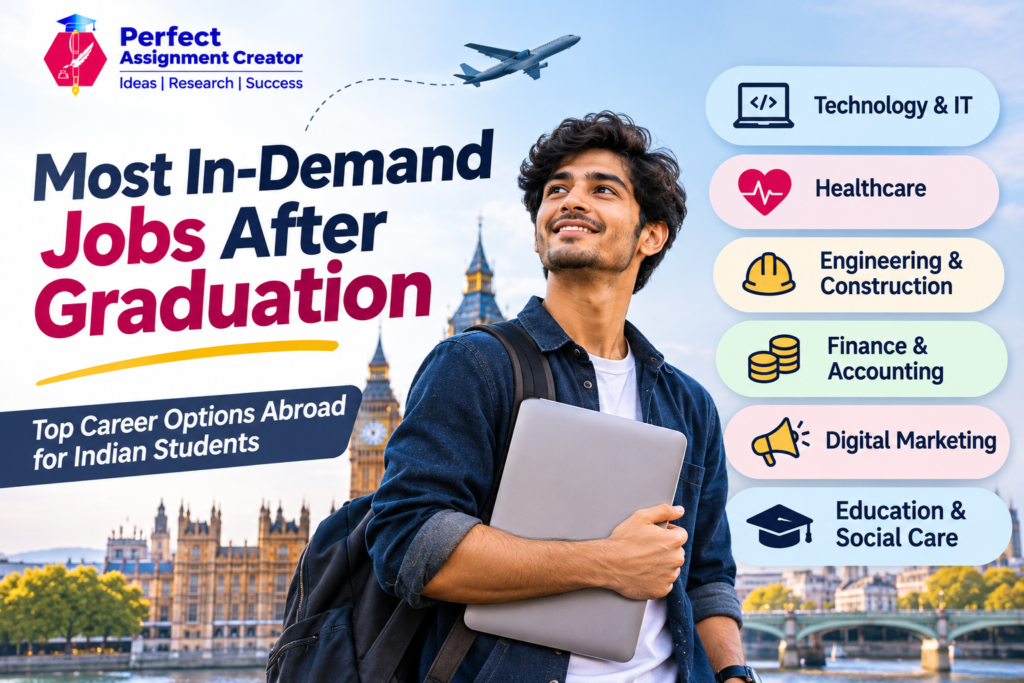
Choosing a university degree is a big decision. But have you thought about what happens after graduation?
For many Indian students planning to study in the UK, Australia, Canada, Malaysia or another country, the ultimate goal is not just earning an international degree. It is building a successful career.
However, the job market is changing. Technology, artificial intelligence, healthcare demands, infrastructure development and environmental changes are influencing which skills employers need.
So, what are the most in-demand jobs after graduation in 2026–2027?
Let’s explore some promising career options, the skills employers look for and the industries worth considering before choosing your degree.
1. Technology and IT Jobs
Technology continues to influence almost every industry, making IT-related careers attractive to graduates.
Some in-demand jobs in this sector include:
Software Developer
Cybersecurity Analyst
Data Analyst
Cloud Engineer
AI and Machine Learning Specialist
IT Business Analyst
Systems Architect
The UK’s 2026 Skills England report identifies digital and technology as one of the sectors expected to need significant additional workers over the next decade. Software development and IT business analysis are among the occupations with strong projected growth.
Useful skills: Python, SQL, cloud computing, data visualisation, cybersecurity and problem-solving.
Suitable degrees: Computer Science, Data Science, Business Analytics, Cybersecurity and Software Engineering.
Tip: An IT degree alone may not be enough. Build a portfolio, complete practical projects and gain internship experience.
2. Healthcare and Life Sciences
Healthcare is another important employment sector across several countries.
Potential career options include:
Registered Nurse
Physiotherapist
Healthcare Manager
Clinical Research Associate
Medical Laboratory Scientist
Public Health Analyst
Occupational Therapist
Canada’s 2026 healthcare workforce report recorded a 6.5% increase in registered nursing employment between 2024 and 2025, highlighting the continuing importance of healthcare professionals.
Useful skills: Communication, patient care, research, clinical knowledge and teamwork.
Suitable degrees: Nursing, Public Health, Biomedical Science, Healthcare Management and Physiotherapy.
Remember that many healthcare professions require local registration, licensing or professional accreditation before you can practise.
3. Engineering and Construction
Infrastructure development, housing projects and energy investments are creating demand for technical professionals.
Some potential in-demand jobs include:
Civil Engineer
Mechanical Engineer
Electrical Engineer
Quantity Surveyor
Construction Project Manager
Structural Engineer
Renewable Energy Engineer
Australia’s 2026 Occupation Shortage List identifies persistent shortages in construction, engineering, electrotechnology and telecommunications-related occupations.
The UK also projects substantial workforce growth in construction over the next decade.
Useful skills: AutoCAD, project management, technical design, problem-solving and industry-specific software.
Suitable degrees: Civil Engineering, Mechanical Engineering, Electrical Engineering and Construction Management.
4. Finance, Accounting and Business Analytics
Businesses increasingly rely on financial reporting, data analysis and risk management to make decisions.
Graduates can explore roles such as:
Financial Analyst
Accountant
Auditor
Risk Analyst
Business Analyst
Management Consultant
Financial Planning Associate
These careers are particularly relevant to students studying finance, accounting, economics and business analytics.
Useful skills: Excel, financial modelling, SQL, Power BI, accounting software and analytical thinking.
Suitable degrees: Finance, Accounting, Economics, Business Analytics and Management.
Professional qualifications such as ACCA and CFA may also strengthen your profile, depending on your intended career.
5. Digital Marketing and Business Development
You don’t necessarily need a technology or engineering degree to explore growing career opportunities.
Businesses across industries require professionals who understand customers, digital platforms and online marketing.
Some options include:
Digital Marketing Executive
SEO Specialist
Social Media Manager
Marketing Analyst
Business Development Executive
Content Strategist
E-commerce Specialist
Malaysia’s Department of Statistics reported advertising and marketing professionals, accountants and auditors, and software developers among its five popular job groups in its second-quarter 2026 job-market report.
Useful skills: SEO, Google Analytics, content strategy, communication, advertising platforms and data analysis.
Suitable degrees: Marketing, Business Management, Digital Marketing and Communications.
6. Education, Social Care and Professional Services
Education and social care also offer career paths for graduates.
Potential roles include:
Teacher
Education Support Professional
Early Childhood Educator
Social Worker
Care Service Manager
Learning and Development Specialist
These roles are particularly relevant to students with backgrounds in education, psychology, social sciences and healthcare.
However, teaching, social work and certain childcare roles may require professional registration or specific local qualifications.
Which Countries Offer Opportunities in These Industries?
Different countries have different employment priorities.
Country | Sectors worth exploring |
|---|---|
🇬🇧 UK | Digital technology, construction, healthcare, engineering and creative industries |
🇦🇺 Australia | Healthcare, engineering, construction, technical occupations and education |
🇨🇦 Canada | Healthcare, education, STEM, trades and transport |
🇲🇾 Malaysia | Technology, marketing, accounting, engineering and professional services |
These areas reflect recent government labour-market reports and occupational priorities, not guaranteed vacancies for international graduates.
What Skills Should You Develop Before Graduation?
A degree is important, but employers also want candidates who can apply their knowledge in practical situations.
Skills that can strengthen your graduate profile
Technical skills | Professional skills |
|---|---|
Data analysis | Communication |
Excel and Power BI | Teamwork |
Programming | Problem-solving |
Digital marketing | Adaptability |
Project management | Critical thinking |
Industry-specific software | Time management |
Your career preparation roadmap
Choose a relevant degree
          ↓
Develop industry skills
          ↓
Complete practical projects
          ↓
Gain internship experience
          ↓
Build professional connections
          ↓
Apply for graduate jobs
Important: Having skills in a high-demand occupation does not automatically guarantee employment or visa sponsorship. Check local work-permission rules, employer requirements and professional registration conditions.
Are These Jobs Easy to Get as an International Graduate?
Not necessarily.
Even when industries report skill shortages, employers may prefer candidates with relevant experience.
For example, a UK government analysis published in June 2026 found that entry-level hiring was down 14% year-on-year in April 2026, although some customer-facing occupations were growing (Gov.UK).
This means students should prepare before graduation rather than relying entirely on their degree.
Internships, university projects, volunteering, networking and industry certifications can help demonstrate your practical abilities.
Final Thoughts
The most in-demand jobs after graduation are spread across technology, healthcare, engineering, finance, marketing, education and other professional sectors.
For Indian students planning to study abroad, choosing the right degree should involve more than looking at university rankings or tuition fees.
Research the employment market, understand the skills employers need and consider whether your intended profession requires additional qualifications or registration.
Most importantly, start preparing for your career while you are still studying.
An international degree can open doors, but your skills, experience and career planning will help you make the most of those opportunities.
Labour-market information checked on 2 November 2026. Employment demand varies by country, region, experience level and industry. Always consult official government employment data and professional regulators before making career decisions.
Read our previous blog here!