

How to Manage Assignment Deadlines Without Last-Minute Stress.
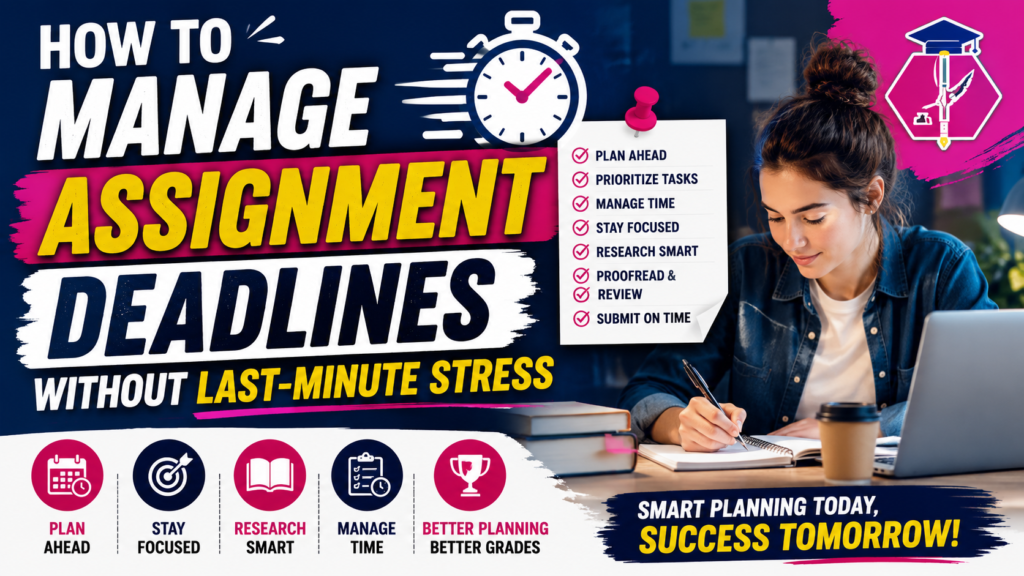
How to Manage Assignment Deadlines Without Last-Minute Stress. Instruct students to break down their assignments into smaller, more manageable tasks. Encourage students to divide assignments into smaller, more manageable tasks. Student life is exciting, but with it comes one thing that affects nearly every one of us: the deadlines for assignments. When several assignments are coming due simultaneously, it can sometimes be overwhelming, regardless of whether you’re attending full-time, part-time or have loads of responsibilities at home. Fortunately, having to work to deadlines doesn’t need to be stressful. You can get your work done on schedule without compromising the quality of your assignment with adequate planning and study skills. The following are some time-saving ideas that will help keep you organised and stress-free.
1. Complete as soon as the assignment has been received
The most common errors that students make are waiting till the last few days to give their assignments. If you don’t start writing right away, carefully read the assignment brief.
Understand:
What question(s) is the topic posing
The minimum and maximum word count that should be adhered to.
The referencing style Submission date Assessment criteria
It will save you time in the long run, and it will help you to avoid any mistakes that you don’t need.
2. Divide the Assignment into smaller tasks.
The thought of tackling an assignment of 3,000 words or more can be daunting. Don’t think of the whole project; break it up into small steps
For example:
Follow the guidelines on the assignment. Read the assignment directions
Choose your topic
Conduct research
Organise your notes
Create an outline
Write the introduction
Make sure that the main body is finished.
Fill in the main body.
Write the conclusion
Add references, proofread, and edit
Have you finished one thing at a time? It will seem a lot less overwhelming, and you’ll stay motivated.
3. Students will develop a Weekly Study Schedule.
It is very important to have a simple study plan that can make a big difference. Make time to do assigned work daily. Just an hour or two is more useful than a night’s catch-up. Get a planner, calendar or digital planner to stay on track with deadlines.
Having a visual or calendar representation of your schedule makes it easier to stay organised and to not miss important dates.
4. Prioritise Your Assignments.
Not every homework will take the same amount of work. Ask yourself: Determine in which order assignments will be completed.
Which of the two has the best mark?
Which needs to be researched more?
Do the most important tasks first and keep working on the other tasks, but be sure to make steady progress on them.
Knowing how to prioritise can help to decrease the stress that can occur during the busiest times of school.
5. The students mustn’t skip the Research Stage.
Unfortunately, many students rush into writing without taking a sufficient amount of time to research. A good assignment will be written with the help of quality research. Adhere to the use of credible academic journals, books, university libraries and credible educational websites.
Good research can enable you to:
Build stronger arguments
Enhance the quality of writing (as appropriate)
Find credible evidence
Avoid claims that lack supporting evidence or are overly vague. Don’t make weak or unsupported claims.
Keep in mind that a good paper starts with good research.
6. Avoid Multitasking.
While it might seem to be productive to work on several assignments at the same time, flitting from one assignment to another decreases concentration. Rather, work on one task for a specific length of time. There are some techniques that you can use, such as the Pomodoro Method: Study for 25 minutes, take a 5-minute break, repeat the cycle. This not only helps to focus but will also help to avoid mental fatigue.
7. Eliminate Distractions.
The constant interruptions from your phone, social media and the constant notifications can easily distract your focus. When studying, he should:
Turn your cell phone to Silent.Close browser windows as you don’t need them.
Study in a quiet study space. Only keep materials that you need close at hand.
One hour of free-time study is more productive than three hours of interrupted study.
8. Set aside time to edit and proofread.
There’s no doubt many students will come here and get from writing their paper to uploading it in a matter of minutes. This can result in unnecessary errors. Make sure to always leave sufficient time to
Review grammar and spelling
Improve sentence clarity
Verify references
Remove repeated information
Make sure the answer(s) to the question are correct.
It doesn’t matter how many times you rewrite your work; the final version can still be greatly enhanced.
9. Ask Questions Early.
Don’t dicker with the instructions for an assignment, just get confused about them and don’t wait until the last minute. Clear up any misunderstandings with your lecturer/tutor early! Answers that are received early avoid miscommunication, and valuable time is saved later in the process.
Why Planning Matters.
The perception of students is that they can only get work done by working longer hours in order to meet deadlines. So, successful students generally work more efficiently and not necessarily more diligently. When you plan your assignments, you will have: Better time management, Less stress, Higher-quality work, More confidence, and better academic performance. You will not be in a hurry to work to deadlines, but have the time to research, write, revise and submit your work with pride.
Final Thoughts.
University assignments have deadlines, and while they may be a regular part of university life, they don’t have to cause constant stress. Taking steps to plan, organise, research, and study regularly will help you keep a handle on your workload during the semester. Keep in mind, there is much more that goes into a successful assignment than writing the opening paragraph. Production of quality academic work can be achieved by good preparation, effective time management and steady progress, not by last-minute panics. Remember not to wait until the last week to get an assignment. Practice from the beginning, be well organised, and take one step at a time. You’ll thank yourself in the future for your actions, as will your grades.