

How to Improve Critical Thinking in Academic Writing
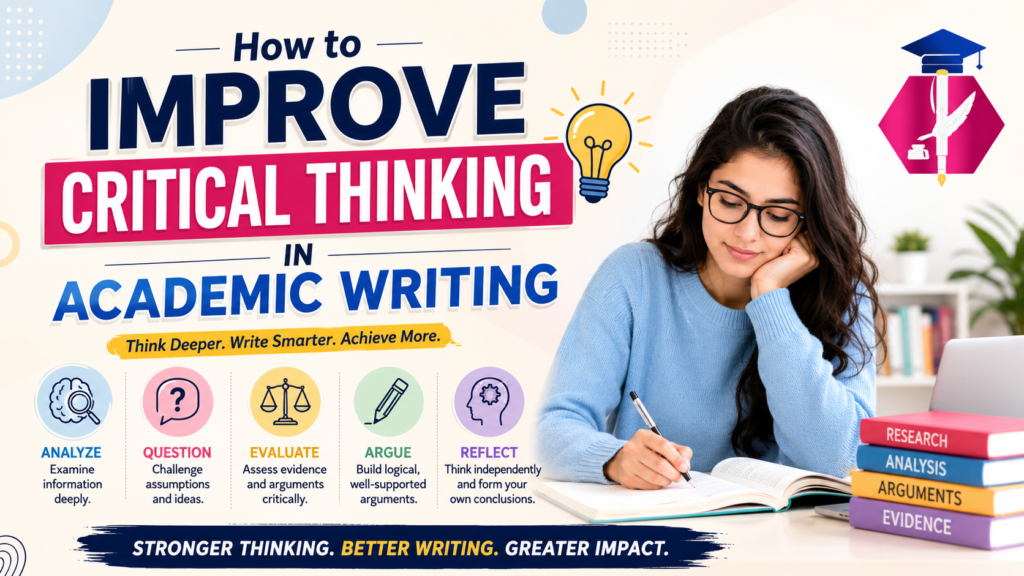
How to Improve Critical Thinking in Academic Writing.To enhance your ability to think critically when writing academic texts.To develop critical thinking in academic writing. Academic writing is more than just writing on a piece of paper. It’s about being able to demonstrate knowledge on a subject, present arguments and ideas in a logical manner and provide authentic supporting evidence. Critical thinking is one of the key skills that can help you get higher marks. Students think that it is just about gathering information from various sources to write well. Information analysis, evaluation and explanation are more important than research. It’s here that critical thinking skills are used. In this blog, we will discuss the meaning of critical thinking, its importance in academic writing and how you can develop this skill to write more effective assignments.
What is Critical Thinking?
Critical thinking involves scrutinising information and not accepting it as truth. It includes questions, comparisons, investigation of evidence and personal opinion built on evidence.
A critical thinker is not just a talker but asks what and why questions such as:
Are you certain that this information is accurate?
What kind of evidence does this have to support this claim?
Do you have other views about this issue?
What are the advantages/disadvantages of this argument?
These are the types of considerations that can be used to develop assignments with originality and understanding.
How will critical thinking be beneficial to you?
Compared to summarising information, universities require more than that from their students. Professors are looking to see that you can think critically and provide supporting arguments for your point of view on various ideas.
Critical thinking is a way to assist you in:
- Write stronger arguments
- Develop Research skills
- Solve academic problems
- Develop logical conclusions
- Develop confidence in writing skills.
If you’re assigned to think about the content of your assignments, rather than just describing them, they’ll be more interesting and meaningful.
Read information from a variety of sources.
An easy way to perfect thinking is to read info from different sources. Never use information from a single article or textbook. Make comparisons of the statements made by various authors on the same subject. You’ll likely find that there are a variety of opinions, methods, or conclusions from the experts.
Multiple sources will aid you in:
Understand different perspectives
Identify common facts
Recognize conflicting opinions
Formulate an opinion of their own
The more that you read, the more things you will know. The more you read, the more things are that you will know. Readers should raise questions to help them better understand the material. Many academic article readers don’t read deeply into articles. Instead, discuss the text by asking questions.
For example:
What was the rationale behind the author’s argument?
What is their reasoning and proof of their opinion?
What other ways do you think this happened?
Do there seem to be any gaps in the information?
These easy questions require analysis to answer and will deepen your knowledge of the subject. To avoid making hasty and impulsive decisions, do not accept anything at once, but think carefully about it first. Not all information found on the web is necessarily accurate and reliable. Use information in assignment – check:
Who wrote it?
Did the source come from an authoritative or credible source?
Is all information up-to-date?
Do the statements have references to back them up?
Your writing will be more trustworthy and a sign of good research skills when you use reliable academic sources.
Organise Your Thoughts Before Writing is a strategy you can use to help you organise your thoughts before writing.
All good academic writing starts with good planning. Take some time organising your ideas prior to writing.
Make an easy outline with the following:
Introduction
Main arguments
Supporting evidence
Counterarguments
Conclusion
A clear structure allows your ideas to flow and makes it easier to follow the ideas. For each argument, provide supporting evidence. Your opinion is important; however, of course, in academic writing, opinions should always be backed up by evidence.
For each claim, provide:
Academic journals
Research studies
Books
Government reports
Reliable publications
Evidence supports your arguments and demonstrates that your conclusions are supported by facts and not opinions.
Ask yourself:
What could be modified to make the arguments more convincing?
What area(s) of the project do I need to gather more evidence in?
What could I do to do my analysis better?
As you read, constructive comments will show you areas where you have weak points and make you a better writer over time. Make the most of your time! Use your time wisely! Developing critical thinking skills is a process that has to be nurtured.
However, when you’re rushed to complete your job, you will likely only be thinking about finishing it and not really considering the matter at hand.
You can get plenty of time if you begin early to:
Conduct research
Read multiple sources
Organize ideas
Edit your work
Review your arguments
Planning will allow you time to create better assignments. Professional Academic Guidance can assist in many ways. Professional Academic Guidance can be of great help in many ways. Numerous students possess knowledge of their topic but cannot present ideas clearly and analytically. This is particularly true of students from other countries who may be adjusting to a new style of writing for their studies.
We at Perfect Assignments Creator know how to overcome these problems. Counselling from our expert academic staff can help students to grasp the expectations of assignments, refine their writing and enhance their academic thinking. Students can learn from models and receive assistance, improving their confidence and effectiveness as writers. We are not only trying to get students to do their homework but to do it more effectively, more critically, and to improve their academic performance continually.
Final Thoughts.
One of the most important skills that one can acquire during the academic journey is critical thinking. It allows you to work beyond gathering information and create thoughtful, well-supported, and meaningful assignments.
Development of critical thinking does not occur quickly. It takes curiosity, practice, careful reading and questioning of information to get it to accept it. Obtaining information from credible sources, posing meaningful questions, fact-checking, and presenting ideas and opinions with evidence will make you a more confident academic writer. Keep in mind that each assignment will be a lesson in acquiring new knowledge and sharpening one’s mind.
With the right guidance and practice, you can enhance your academic writing skills and get better results throughout your academic career. We take pride in helping students on their educational journey at Perfect Assignments Creator with our reliable support and equipping them with the skills they need for success with confidence.