
Digital Learning Trends Every Student Should Know
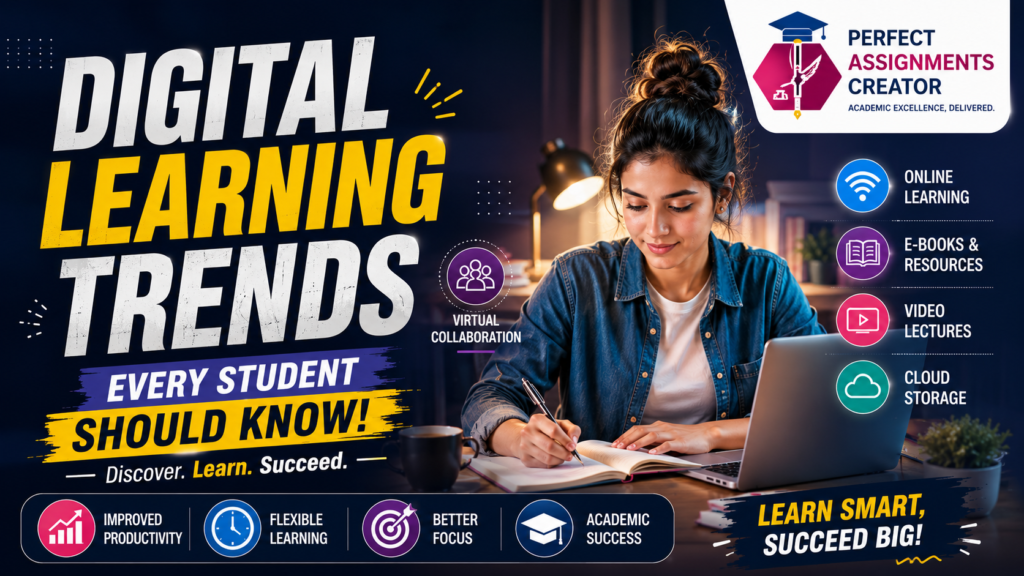
Digital Learning Trends Every Student Should Know. The world of education has undergone a lot of changes in the last few years. The days of students studying from textbooks, class notes and going to the library to finish their studies are gone.
Students learn, research, collaborate and handle their essays in new ways thanks to technology today. Artificial Intelligence has become an integral part of education, along with other online learning platforms. Whether you’re learning at your own institution or abroad, knowing the latest in digital learning trends can make you more effective at learning and ahead of the curve.
Let’s take a look at what are some of the key digital learning trends every student should be aware of in 2026. AI as a learning companion is becoming the norm. The use of Artificial Intelligence as a learning companion is now commonplace.
Education is seeing the biggest revolution with the advent of Artificial Intelligence (AI). AI-powered tools are now helping students to brainstorm ideas, summarise information, organise research, and boost productivity. But successful students know that AI should not take the place of their critical thinking skills.
AI can help students get assistance rapidly, but they have to analyse information, perform correct research and create original ideas. Students are encouraged to use technology responsibly, have academic integrity and be strong in academic skills at Perfect Assignments Creator.
2. Online Learning is Here to Stay.
Online education is very popular these days, all over the world. Today, Universities provide flexible learning, enabling students to take classes, hand in assignments and engage in class discussions from anywhere.
This flexibility can be of great benefit to students from abroad who might have to find a balance between work, personal and study requirements and also part-time employment. Digital learning platforms enable access to recorded lectures, online resources, discussion forums and collaborative tools, which make education more accessible than ever.
Pupils who develop good strategies for using them are likely to do better in school and use their time more effectively. Microlearning is increasing Knowledge Retention. Students are now opting for short and focused learning, which takes place in one sitting, rather than spending hours reading lengthy materials. Microlearning is the approach of dividing complex topics into smaller bites. It aids students in understanding the material better and helps sustain memory.
Microlearning can take the form of:
Short educational videos
Interactive quizzes
Flashcards
Quick tutorials, bite-sized study modules
The majority of successful students use both microlearning and conventional methods of study to enhance their comprehension of the subject and to minimise their study fatigue.
4. The need for Mobile Learning is becoming an essential need.
Smartphones are a formidable learning device! Now students can access learning materials, watch lectures, listen to discussions and do coursework from their cell phones.
Mobile learning has several benefits:
Enjoy learning any time, anywhere!
Resources are easily accessible for studying.
Improved flexibility
Better time management
Mobile learning is a great solution for students from abroad, who are always on the go.
The digital world is changing the way groups work together in group projects.
A University education is often beset with group assignments. In today’s world, students don’t have to get together to work on projects.
- With online tools, students can:
- Share documents instantly
- Concurrently do assignments
- Monitor progress on the fly
- Effectively convey information to various locations
These can be particularly helpful for international students who might be collaborating with other students from other countries and time zones.
Digital collaboration skills will not only help students succeed in the classroom but will also be much in demand in the workplace. Personalized Learning is becoming popular. All pupils are different. Some learn best from video, some learn best from reading, and others learn best from listening and/or practice. Thanks to current information and communication technology, individual learning is becoming possible.
There are currently several learning platforms that tailor content to each student’s strengths and weaknesses, and progress. This will enable students to concentrate on topics that they are less familiar with, and to speed through topics that they are more familiar with. The use of personalised learning contributes to creating a more engaging and effective learning experience.
8. The digital skills gap is growing.
Digital skills are becoming even more important.
Students have access to a vast amount of information via the Internet. Not all online information is reliable or academic in nature, however.
A crucial skill that students can learn is how to recognise credible sources and how to do effective research.
- Pupils should be taught to:
- Use academic databases
- Evaluate source credibility
- Verify information
- Cite sources correctly
- Avoid plagiarism
We believe that good research skills are essential to good academic writing, and so we focus on good research practices at Perfect Assignments Creator.
9. Instructional Support Services are Increasing in Frequency
With the increasing competitiveness of higher education, a number of students are looking for extra academic assistance to enhance their academic achievement. The situations of international students can be different, including language barriers, different academic requirements, cultural changes and time pressures.
Professional academic support services can be beneficial for students who are struggling to understand the requirements of their assignments, need help in writing their assignments and have difficulty managing their workload. This is a trend that is growing because students need help and support to make the transition to challenging school settings. Perfect Assignments Creator remains dedicated to assisting students while offering dependable academic support tailored to help students tackle such challenges with assurance.
10. Managing time is becoming more efficient in the digital age.
11. Digital tools are making time management more efficient.
Taking care of several homework assignments and exams, lectures, and personal commitments can be challenging. Fortunately, today there are a lot of online resources that will help students to be more productive and organised.
Some popular tools that can help with:
Assignment scheduling
Task management
Deadline tracking
Goal setting
Study planning
Good organisational skills can help to reduce stress for students and boost their learning. Digital planning tools are the easiest available to keep on top of academic responsibilities. The 10th lecture was on “Lifelong Learning – the new standard”.The 10th lecture was about “Lifelong Learning – the new standard”. One of the most significant changes in digital learning is a focus on ongoing learning.
Technology changes so quickly that students need to be adaptable to change and continue learning new things over the course of their lives. Post-graduation learning is not the end of the learning process. Prominent online courses, career certificates, webinars and online learning communities help people develop new skills beyond the campus after graduation. A learner for life has a better chance of being successful in the competitive job market in an international society. professional success.
Conclusion.
Education is in the digital, mobile and very personalised future. Today, students have at their fingertips the power of learning tools, mobile learning, online collaboration and academic support services powered by artificial intelligence. As students use digital technology to learn, these trends can assist them to better learn, time manage and improve their academic results. Technology provides great opportunities, but it still takes dedication, critical thinking and a willingness to learn to be successful. We know how tough it can be for students in an ever-evolving educational landscape. We want to offer students academic support that is both professional and inspiring, to build their confidence and enhance their academic learning, to support students’ learning objectives, and to adapt to the future of digital learning. Students can capitalise on these trends and make the most of the resources available by applying them effectively, ensuring they are geared towards their academic and professional growth and success for years to come.