

New UK Banking Rules for International Students: What Changed in 2026?
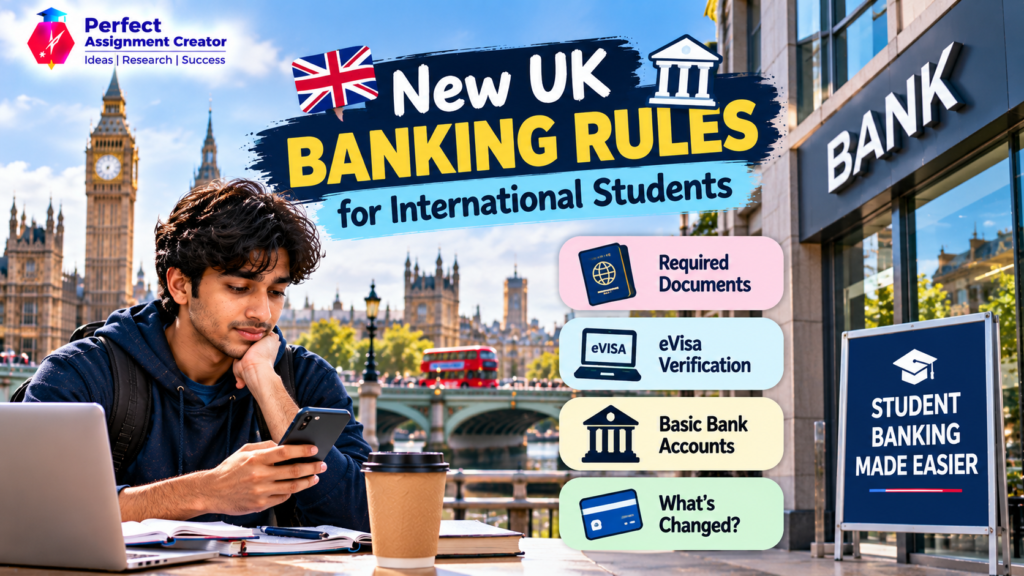
New UK Banking Rules for International Students: What Changed in 2026?
Moving to the UK for university involves more than arranging accommodation and paying tuition fees. You also need a reliable way to receive money, pay rent, buy groceries and manage everyday expenses.
For Indian students arriving in the UK, opening a bank account can sometimes be confusing. You may be asked for identification, proof of address, university documents or evidence of your immigration status.
So, what are the latest UK banking rules in 2026? Have banks introduced new requirements for international students?
The important thing to understand is that there is no single new banking rule specifically for international students. However, changes to the digital immigration system and new commitments to improve access to basic bank accounts are relevant to students opening an account.
Let’s explore what you need to know.
1. The Latest UK Banking Rules: What’s New in 2026?
One significant development came on 7 July 2026, when the Financial Conduct Authority (FCA) announced that nine major UK banks and building societies had committed to improving access to basic bank accounts.
The announcement followed an FCA investigation that found inconsistent service for people who struggled to open accounts, particularly those without standard identification or a fixed address. The banks committed to clearer communication, simpler processes and better alternatives to online-only applications.
What could this mean for students?
Students who struggle to provide standard documents may benefit from better support.
Applicants may have more opportunities to explore alternative application methods.
Banks should make it easier to identify an appropriate basic account.
However, this does not guarantee approval for every international student. Banks must still follow identity-verification, anti-money-laundering and immigration-check requirements where applicable. The FCA announcement concerns access to basic accounts generally, rather than a new entitlement created specifically for students.
2. eVisa Checks Have Changed How Students Prove Immigration Status
If you studied or researched UK banking a few years ago, you may have seen advice recommending that students present their Biometric Residence Permit (BRP).
The UK has moved to a digital immigration system, and eVisas have replaced physical immigration documents for most visa holders. Your eVisa records your identity, immigration status and relevant conditions.
Banks can use the official digital checking process to verify immigration status and identity. Students can access their eVisa through a UK Visas and Immigration (UKVI) account and generate a share code when required.
What should you prepare?
Before applying for a bank account:
Make sure you can sign in to your UKVI account.
Check that your eVisa details are correct.
Generate a share code if your chosen bank requests one.
Ask the bank whether it accepts digital immigration-status evidence.
You should not assume that every bank follows exactly the same application process.
3. What Documents Do International Students Need?
One of the most common questions about UK banking rules is which documents are required to open an account.
The answer depends on the bank and the account you choose. UKCISA advises international students to check the requirements of their chosen bank before applying.
Here is a practical checklist.
Document | Why you may need it |
|---|---|
Indian passport | Identity verification |
eVisa or immigration share code | Immigration-status checks, where required |
University bank letter | Confirmation of student status and address |
Proof of UK address | Address verification, where required |
Student ID card | Additional supporting information |
Contact details | Account setup and communication |
Tip: Ask your university how to obtain a bank letter confirming your enrolment and UK address. Make sure your name and address match the details on your application.
Requirements vary, so confirm the accepted documents directly with your chosen bank.
4. Can International Students Open a Basic Bank Account?
Yes, an eligible international student can consider a basic bank account if a standard current account is difficult to obtain.
A basic account generally allows you to receive money, make payments and pay bills, but it does not provide an overdraft. It is usually fee-free. Some banks also offer accounts designed for international students.
Basic account vs. standard current account
Feature | Basic account | Standard current account |
|---|---|---|
Receive money | Yes | Yes |
Pay bills | Yes | Yes |
Debit card | Depends on provider | Depends on provider |
Overdraft | No | May be available, subject to approval |
Monthly fee | Usually free | Varies by account |
If your application for a standard account is unsuccessful, ask the bank whether a basic account is an option. Do not assume that you will qualify automatically.
5. What Happens If Your Immigration Status Changes?
The existing UK immigration-check rules remain important in 2026.
Banks and building societies must check new current-account applicants against relevant immigration-status information. They must also carry out periodic checks on existing current accounts. These rules are aimed at identifying people who are legally disqualified from opening or operating a current account; they do not mean that international students are automatically barred from banking.
If you extend your Student visa, receive a different immigration status or replace your passport, keep your UKVI information updated as appropriate and respond to legitimate requests from your bank.
Also, notify your bank promptly if your address or other personal details change.
6. How Can Indian Students Prepare for Banking in the UK?
Before arriving, compare account options and understand the documents each provider accepts.
After arrival, follow this simple process:
Choose a bank
      ↓
Check its document requirements
      ↓
Prepare passport and eVisa details
      ↓
Get a university bank letter if needed
      ↓
Submit your application
      ↓
Complete verification
      ↓
Activate your account and card
Keep enough accessible money for your first few weeks, because opening an account may take time.
Also, never share banking passwords, one-time passcodes or security details with anyone claiming they can guarantee account approval.
Final Thoughts
The latest UK banking rules are particularly relevant to Indian students who are opening an account for the first time.
The key developments to understand are the FCA’s July 2026 commitments to improve access to basic bank accounts and the continued use of digital eVisas for immigration-status verification. Neither development removes banks’ obligations to verify identity or follow applicable immigration checks.
Before applying, prepare your passport, eVisa information, university documentation and address details. Compare account features, check eligibility and ask about a basic account if necessary.
A little preparation can make managing your money in the UK much easier from the beginning of your student journey.
This guide reflects official information available on 22 October 2026. Banking policies and document requirements vary by provider, so confirm the latest requirements with your chosen bank and consult the official UKCISA bank-account guidance.
Read our previous blog here!