

My Turnitin Score Is High: Should I Panic? (A Student’s Survival Guide)
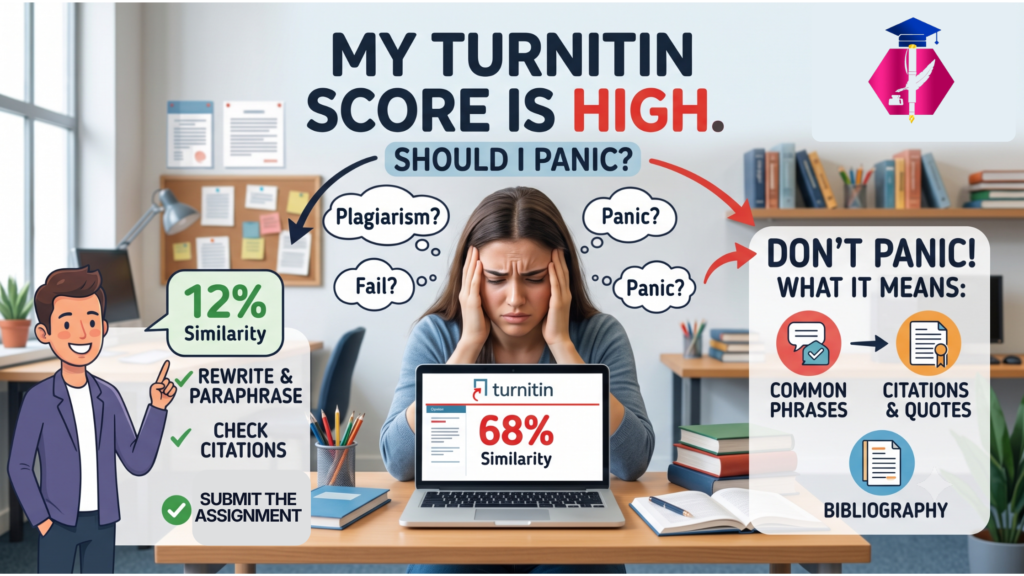
My Turnitin Score Is High: Should I Panic? (A Student’s Survival Guide)
You have spent days researching, drafting, typing, and editing your university assignment. You finally upload your draft to Turnitin, take a deep breath, and wait for that little colored box to load.
Then it appears.
34% (Orange). Or maybe 45% (Red).
Your heart sinks. A sudden rush of panic sets in. “Am I going to get expelled? Will my professor think I cheated? Did I accidentally copy someone else’s work?”
Take a deep breath and step away from the panic button.
Having a high Turnitin score does not automatically mean you are in trouble, nor does it mean you are guilty of plagiarism. In this complete, beginner-friendly guide, we will break down what Turnitin actually measures, why your score might be high despite honest writing, and how you can reduce that percentage safely and effectively.
The single biggest misconception among university and college students is equating a similarity score with a plagiarism score.
Turnitin does not check for plagiarism. It checks for text matching (similarity).
Turnitin is an algorithm, not a human professor.
It highlights matched words, not intent or context.
What Turnitin Does:
- It scans your submitted document against billions of web pages, published academic journals, books, articles, and millions of student papers stored in its global repository.
- When it finds a sequence of words in your paper that matches a sequence of words elsewhere, it highlights that string and calculates a mathematical percentage of matched words compared to your total word count.
What Turnitin CANNOT Do:
- It cannot tell if you properly cited an author using standard quotation marks unless your instructor set filters to exclude quotes.
- It cannot recognize that standard phrases (like “The purpose of this study is to analyze…” or “According to the World Health Organization…”) are common academic conventions, not copied thoughts.
- It cannot judge whether your matching methodology section is standard laboratory protocol or stolen work.
Therefore, a high percentage simply means: “A notable portion of the exact words in this paper also exist in our database.” It is your professor’s job to open the report and review why those words matched.
- Understanding Turnitin’s Color Codes
Turnitin assigns a color flag to your submission depending on the overall similarity percentage:
Color Code | Percentage Range | What It Generally Means |
Blue | 0% matching text | No matching text detected (or filters are extremely high). |
Green | 1% to 24% | Standard range for most academic assignments and essays. |
Yellow | 25% to 49% | Moderate similarity; requires review of quotes and citations. |
Orange | 50% to 74% | High similarity; needs immediate attention and rewriting. |
Red | 75% to 100% | Critical similarity; almost the entire paper matches existing sources. |
While green is the universally safe zone, seeing yellow or even orange does not guarantee academic disciplinary action. It simply means you need to look inside the report.
- Top 6 Harmless Reasons Your Turnitin Score Is Sky-High
Before assuming the worst, let’s look at why your score might have spiked without any dishonest intent on your part.
Reason #1: Your References and Bibliography Are Being Counted
Turnitin scans your entire document by default. If your assignment contains 40 academic sources in the bibliography, that reference list contains hundreds of exact-match author names, book titles, and journal URLs. A large reference list alone can add 10% to 15% to your total similarity score!
Reason #2: Direct Quotes and Definitions
If your assignment asks you to evaluate legal statutes, medical terms, institutional policies, or direct literary quotes, every single quoted sentence will trigger a match. Even if you placed quotation marks around the text and added a proper citation (e.g., Smith, 2023, p. 45), the basic text matcher flags the identical words.
Reason #3: The Assignment Cover Page and Standard Templates
Did your university provide a mandatory cover sheet containing module codes, tutor names, assignment titles, and declaration paragraphs? Thousands of students use that exact template every semester. Turnitin highlights all of it as a 100% match.
Reason #4: Common Academic Phrases and Discipline Jargon
Academic writing relies on standard phrases such as:
- “In recent years, there has been an increasing interest in…”
- “The results of this study indicate a significant relationship between…”
- “Data was collected using a semi-structured interview approach.”
These multi-word strings exist across millions of published research papers. Turnitin flags these generic phrases even though they are standard academic vocabulary.
Reason #5: Accidental Self-Plagiarism (Submitting to Multiple Portfolios)
Did you upload your draft to your university’s trial folder, your draft inbox, and then the final submission link? If the initial link was configured to store papers in the repository, your final submission might match your own earlier draft at 95% to 100%.
Reason #6: Standard Methodology Steps
If you are writing a scientific lab report or a financial accounting breakdown, standard equations, procedural steps, and formula names are identical across all student submissions.
- What Is an “Acceptable” Turnitin Percentage?
Universities rarely set a single, rigid “pass/fail” number for Turnitin scores because context matters. However, general academic standards across UK, US, Australian, and Canadian universities follow these typical benchmarks:
- Under 15%: Excellent. This is the ideal range for original essays, dissertations, and research proposals.
- 15% to 25%: Generally acceptable. Most tutors consider this standard, especially if your paper has technical definitions, direct quotes, and a detailed bibliography.
- 25% to 35%: Borderline. Your professor will likely inspect the similarity report to see if the matches are bibliographic or copied body paragraphs.
- Above 35%: High risk. Even if citations are present, a score this high suggests over-reliance on external words rather than independent synthesis and critical thinking.
- How to Read Your Turnitin Match Overview Report Like a Pro
To fix your score, you must look beyond the overall number and examine the Match Overview panel.
[Your Document] ——–> [Turnitin Match Overview]
├── Source 1: 3% (Direct quote from Journal)
├── Source 2: 2% (Standard definition)
├── Source 3: 12% (Your Reference List)
└── Source 4: 1% (Cover Sheet)
- Check the Largest Single Source: A 25% overall score where the largest single match is 2% is generally healthy—it means you have small, scattered matches. But a 25% score where 20% comes from a single source is a major red flag indicating a copied block of text.
- Apply Filters: If your student portal allows it, toggle “Exclude Bibliography” and “Exclude Quotes.” Watch your score drop immediately. If the score falls from 32% down to 11%, your high initial score was purely due to formatting and quotes.
- Inspect Highlight Patterns:
- Scattered highlights (a few words per line): Normal academic vocabulary.
- Solid blocks of highlighted paragraphs: Sections that need immediate rewriting and paraphrasing.
- Step-by-Step: How to Reduce Your High Turnitin Score Safely
If your similarity score is sitting uncomfortably high and the matches are in your actual body paragraphs, here is how you can resolve it before your deadline:
Step 1: Master the “Read-Look Away-Write” Paraphrasing Technique
Do not rewrite a source sentence-by-sentence with a thesaurus. Swapping words with synonyms often results in awkward phrasing known as “patchwriting,” which Turnitin still detects.
Instead:
- Read the original paragraph twice until you understand its core idea.
- Close the book or minimize the browser tab.
- Explain the idea in your own natural words as if you were explaining it to a classmate.
- Compare your written version with the original to ensure you did not copy sentence structures.
- Add the proper in-text citation immediately.
Step 2: Convert Overused Direct Quotes into Paraphrased Analysis
Professors look for your voice, not a collage of quotes from other scholars.
- Before (High Match): As stated by Davis (2021, p. 12), “Supply chain management plays an indispensable role in maintaining customer satisfaction during unexpected global disruptions.”
- After (Original Synthesis): During periods of international disruption, maintaining resilient supply networks is vital for preserving consumer trust and fulfilling demand (Davis, 2021).
Step 3: Vary Your Sentence Openers and Structures
If a journal article uses an active, cause-and-effect sentence (“A led to B because of C”), express the thought using a different perspective (“The emergence of B was largely driven by A, particularly when considering C”).
Step 4: Remove Unnecessary Jargon and Filler
Avoid lengthy, generic introductory statements. Get straight to your analytical point.
Step 5: Check University Submission Settings
If your university allows multiple draft submissions before the final deadline, take advantage of the feedback window. Make revisions, re-upload, and allow 24 hours for the new report to generate.
- What You Should NEVER Do (Risky Hacks That Backfire)
When panic strikes, students sometimes turn to internet “tricks” to cheat Turnitin. These tactics almost always lead to severe penalties:
- ❌ Replacing English letters with Cyrillic or Greek characters: Turnitin’s modern character-recognition engine instantly flags mismatched Unicode character sets and alerts your tutor to deliberate evasion.
- ❌ Pasting hidden white text or white punctuation: Turnitin extracts raw text and strips away background styling. Tutors can see hidden characters clearly in the plain text view.
- ❌ Running your text through automated spinning tools: Free AI text spinners often produce robotic, unreadable grammar that makes little sense to human evaluators.
- ❌ Uploading to random, unverified third-party checking websites: Some free online plagiarism checkers store your paper in public databases. When you later submit your work to your official university portal, Turnitin marks your own paper as 100% plagiarized against the website you tested it on!
- Summary Checklist: What to Do Before Submitting
[ ] Step 1: Did you check if the match is coming from References or the Cover Page?
[ ] Step 2: Is any single external source responsible for more than 4-5% of matches?
[ ] Step 3: Have you replaced large direct quotations with original paraphrasing?
[ ] Step 4: Are all citations accurate and formatted according to your required style (Harvard, APA, MLA)?
[ ] Step 5: Is your writing natural, clear, and focused on critical evaluation?